
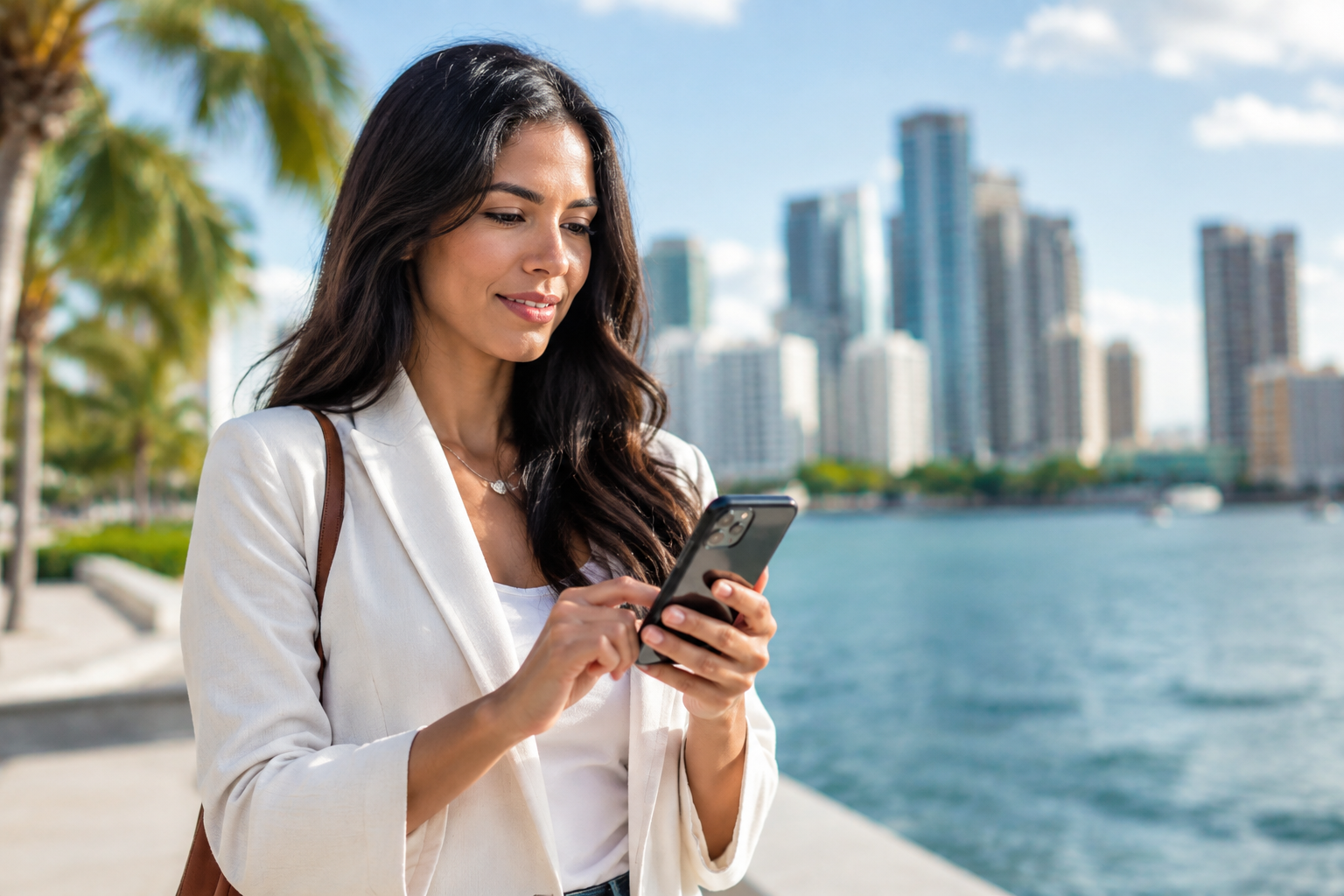
Walk into any cafeteria in Little Havana, any barbershop in Hialeah, or any nail salon in Doral and you will hear Spanish before you hear English. That is not a cultural detail. That is your customer base talking, and if your marketing is not talking back in the same language, you are handing revenue to whoever is.
Miami is 71.5 percent Hispanic according to the U.S. Census Bureau, and roughly 66 percent of residents speak Spanish at home. Running an English-only marketing strategy in this market is not a neutral default. It is an active choice to ignore the majority of the people around you. And in 2026, with Hispanic household purchasing power sitting at $4.1 trillion nationally, that choice has a real dollar amount attached to it.
The Gap Is Bigger Than Most Business Owners Realize
Here is a number that should stop any Miami business owner mid-scroll: in the first quarter of 2025, U.S. online retailers spent $363 million on English-language digital ads and just $3.4 million on Spanish-language digital ads, according to Nielsen data reported by eMarketer. That is less than one percent of digital ad investment aimed at roughly one in five Americans.
In Miami, where that ratio is flipped and Hispanics are the majority, the gap is even harder to justify. What it means practically is that Spanish-language digital advertising in this city is one of the least contested spaces in local marketing. The businesses showing up there are not fighting for attention the way they are in English-language feeds. They are walking into a room where almost nobody else bothered to show up.
That is not a trend. That is a structural opening, and it is sitting right here in South Florida.
Google Translate Is Not a Bilingual Strategy
This is where a lot of small businesses get stuck. They know they should be doing something in Spanish, so they run their English copy through a translation tool, post it, and call it done. The problem is that machine translation handles words, not meaning. It does not know that your Miami audience skews Cuban and Caribbean, not Mexican. It does not understand that certain phrases land completely differently depending on dialect. And it absolutely cannot replicate the tone that makes someone feel like a brand actually gets them.
The California Milk Processor Board nearly translated “Got Milk?” into a phrase that meant “Are you lactating?” in Spanish. A literal word-for-word translation of your best English tagline can produce something that reads as careless at best and offensive at worst. In a market where 75 percent of Hispanic consumers say they prefer to buy products in Spanish, a sloppy translation does not just fail to convert. It actively signals that you did not care enough to do it right.
What actually works is what the industry calls transcreation: rebuilding the message from the ground up with the cultural context of your specific audience in mind. For Miami, that means Caribbean Spanish, not a generic neutral Spanish that sounds like it was written for a national brand with no zip code. It means understanding that your Hialeah customer and your Brickell customer may both speak Spanish but are not the same person.
What Bilingual Campaigns Actually Do for Revenue
The data on this is consistent. 54 percent of Hispanic consumers are more likely to buy from brands that communicate in Spanish, and 88 percent of digital-using Hispanics pay attention to online ads that include aspects of their culture, regardless of the language the ad is in. That second number matters because it tells you this is not purely a language issue. It is a cultural relevance issue. Language is one signal of that relevance, but it is not the only one.
Brands that advertised consistently on Hispanic-targeted media saw 12 percent higher return on ad spend compared to brands that invested nothing in the channel, according to a Spanish Broadcasting System analysis of Nielsen data. And a TelevisaUnivision benchmark found that brands sustaining a Hispanic-audience presence for more than 20 weeks a year see roughly double the ROI of inconsistent advertisers.
For a local Miami business, this translates directly. A restaurant in Coral Gables running bilingual social ads is not just reaching more people. It is reaching people who are actively more likely to convert when they feel seen. A law firm in Miami Lakes running Spanish-language Google ads is not just expanding its reach. It is entering a search environment where the competition is dramatically thinner than in English.
The Bicultural Reality of Miami’s Market
One thing that trips up businesses new to bilingual marketing is the assumption that their audience is either Spanish-speaking or English-speaking. In Miami, most people are both. 96 percent of bicultural Latinos speak English conversationally or fluently, and 92 percent are conversational or fluent in Spanish. They move between both languages depending on context, and they notice when a brand moves with them.
This is why the most effective bilingual campaigns in South Florida are not just translated versions of English content. They are built with a bilingual audience in mind from the start. That might mean a social post that opens in Spanish and closes in English. It might mean a paid ad that uses Spanglish in a way that feels natural rather than forced. It might mean a landing page that defaults to Spanish for certain zip codes. The execution varies, but the underlying principle is the same: meet people where they actually are, not where it is easiest for you to reach them.
69 percent of bicultural Latinos notice and appreciate when brands engage during cultural moments. In Miami, those moments are everywhere. Calle Ocho Festival. Three Kings Day in January. Noche Buena in December. The start of hurricane season. The Heat playoffs. A bilingual marketing calendar built around the actual rhythm of Miami life will outperform a generic content plan every single time.
What This Looks Like for a Small Business Right Now
You do not need to overhaul everything at once. The businesses we work with at By Afro typically start with the highest-traffic touchpoints: Google Business Profile, paid social, and the homepage. Getting those three things into bilingual shape creates an immediate lift in both reach and conversion before you ever touch the rest of your content.
From there, the work becomes about consistency. A single Spanish-language post in October does not build trust. A brand that shows up in Spanish every week, that runs bilingual promotions around Nochebuena and the Calle Ocho Festival, that responds to comments in the language the customer used, that is what earns the loyalty that 73 percent of bicultural Latinos say makes them open to trying new brands.
The Miami market is not waiting for businesses to figure this out. The businesses already running bilingual campaigns are already capturing the customers you are not reaching. The question is not whether bilingual marketing works in a city that is 71.5 percent Hispanic. The question is how much longer you want to leave that revenue on the table.
If you are ready to build a bilingual strategy that is actually built for Miami and not just translated from somewhere else, By Afro is the team to do it with. We work with South Florida small businesses every day and we know what converts here. Reach out and let us show you what a real bilingual campaign looks like for your market.
Sources
- U.S. Census Bureau QuickFacts: Miami city, Florida
- Miami-Dade Beacon Council: Market Demographics
- iHeartMedia: The Roadmap to Winning Bicultural Latinos in 2026
- Ulatus: Why Spanish Is Essential for Reaching the U.S. Hispanic Market
- Influyente: Marketing in Spanish: When, Why, and How to Connect
- Lionbridge: 10 Best Practices for Marketing to Hispanic Consumers
- Refuel Agency: How Latino Buying Power Is Reshaping the U.S. Market
- UCLA Newsroom: Latino GDP Hits Fourth Largest in the World